Experience
Background, systems, and applied work
My work has consistently focused on understanding complex systems, modeling real-world behavior, and building practical tools that make that information usable.
Foundational Research
(1980–1985)
Shear Wave Velocity Anisotropy (1984)
My work in geophysics, software development, and field interpretation contributed to the first real-world observation of shear wave velocity anisotropy under stress–strain conditions in the Ross Ice Shelf, Antarctica.
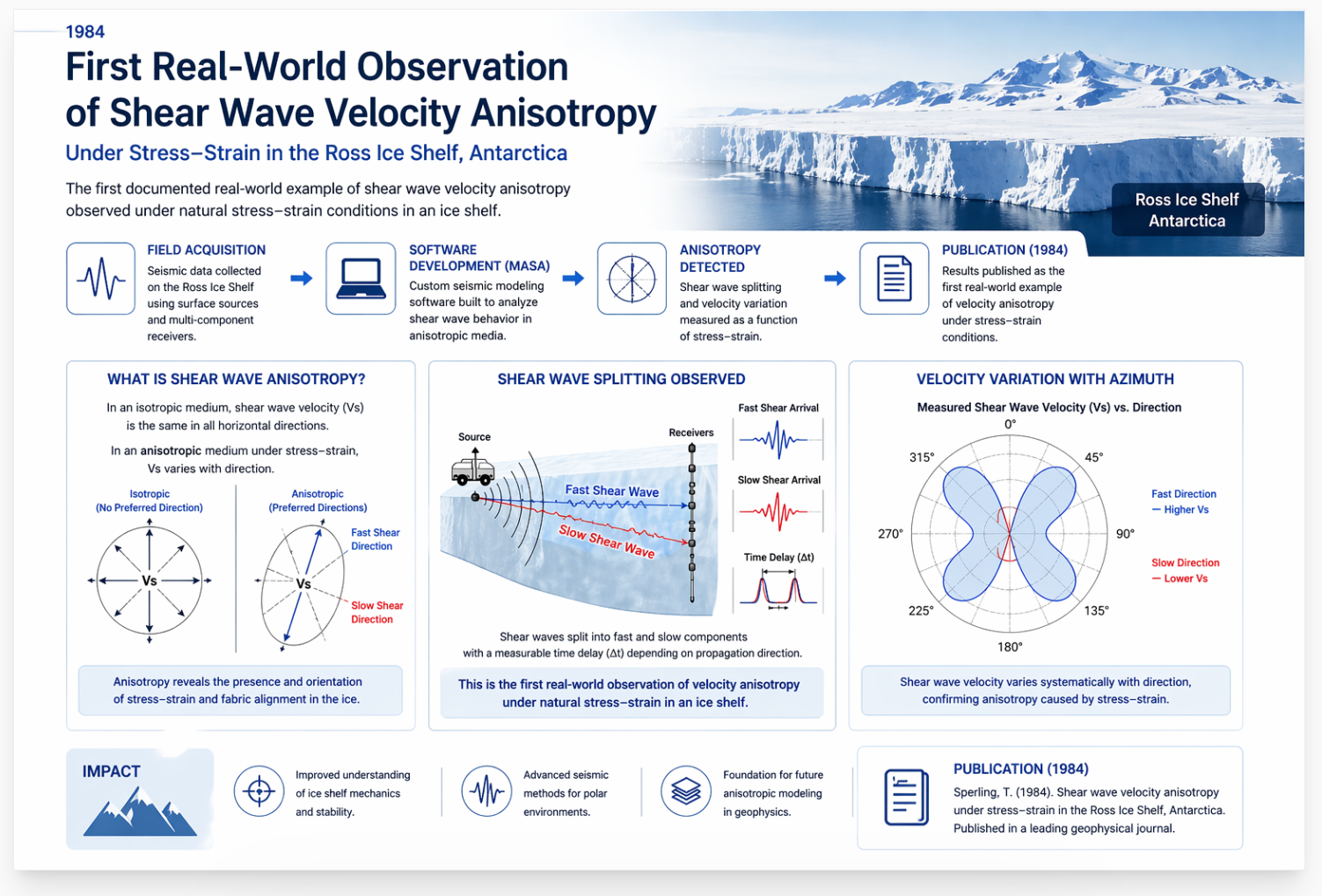
1984 — Ross Ice Shelf, Antarctica. Early field evidence of shear wave velocity anisotropy.
Desktop Oil Discovery (1985)
In 1985, I developed MASA (Micro Assisted Seismic Analysis), one of the first desktop seismic modeling systems. Using an Apple computer, this work led to a documented oil discovery in Michigan — published on the front page of the AAPG Explorer.
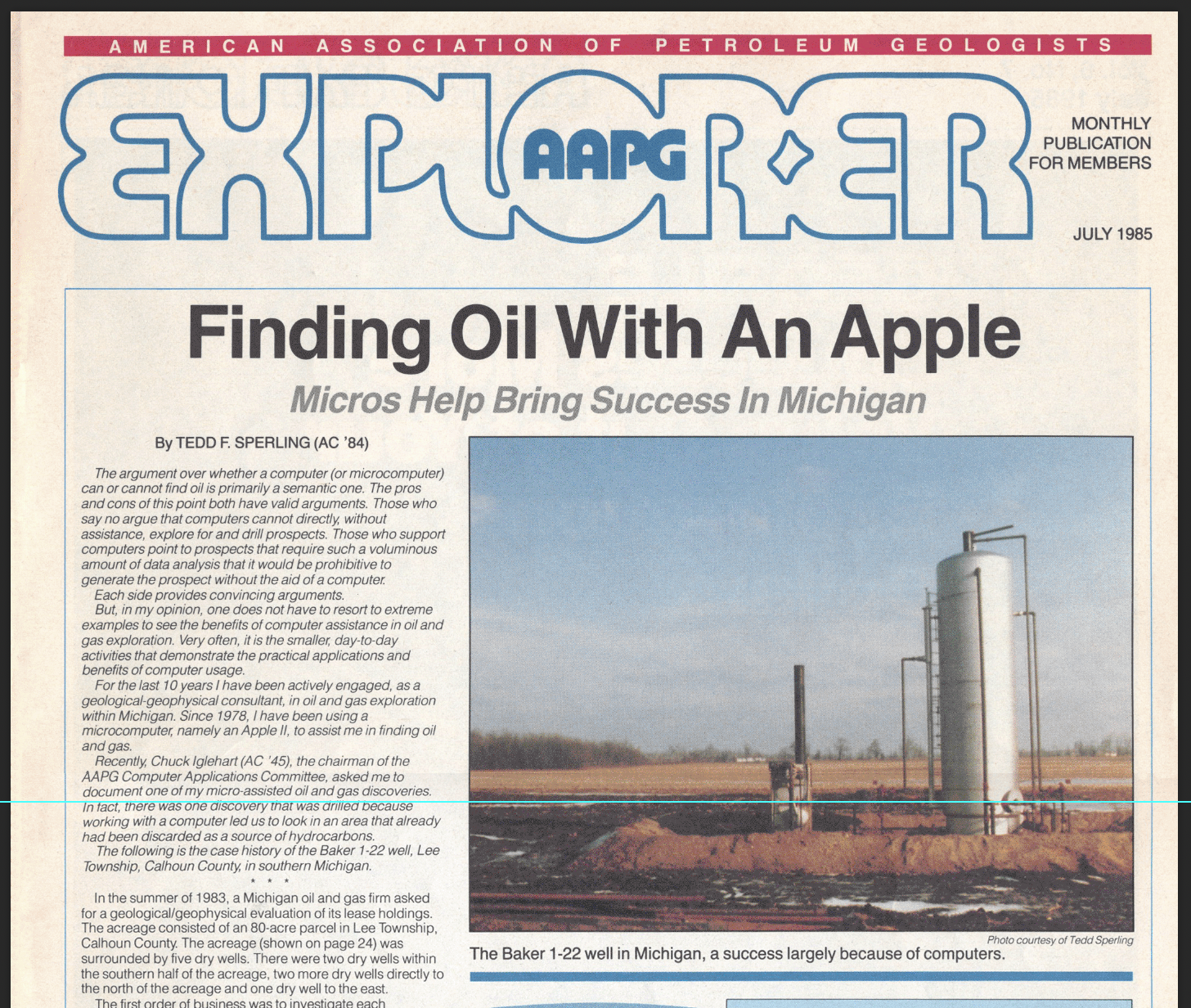
AAPG Explorer, July 1985 — First documented oil discovery using a desktop computer.
MASA: Desktop Seismic Modeling System (1985)
MASA (Micro Assisted Seismic Analysis) was a fully integrated seismic modeling system developed for early desktop computers with extremely limited memory and processing power.
- Generated acoustic impedance from digitized sonic and density logs
- Determined required digitization resolution for accurate synthetic results
- Produced industry-standard synthetic seismograms using wavelet convolution (Ricker, Klauder)
- Included ray tracing for seismic acquisition design and parameter analysis
- Modeled subsurface structure for direct comparison with field data
MASA was not just a modeling tool—it was a complete system for understanding how seismic data is generated, processed, and interpreted under real-world constraints.
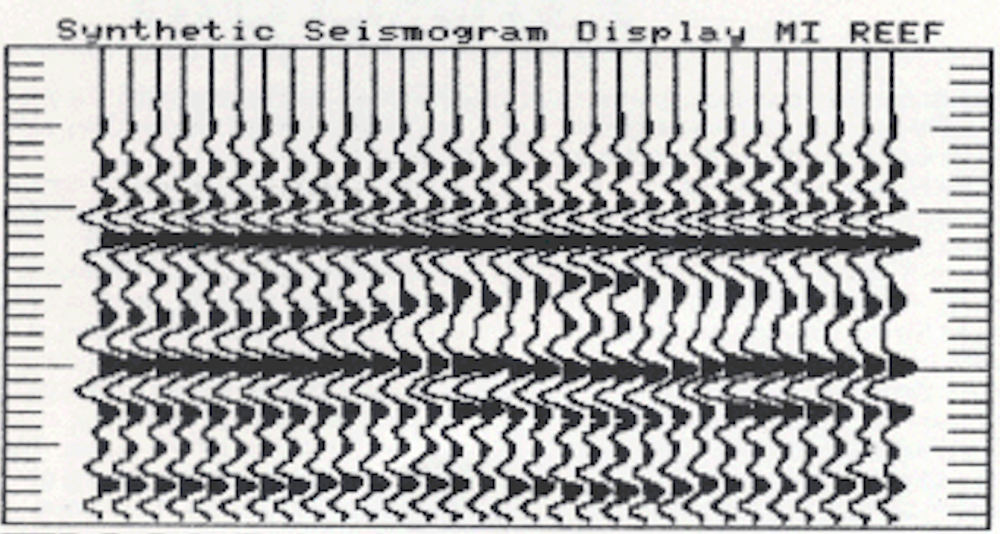
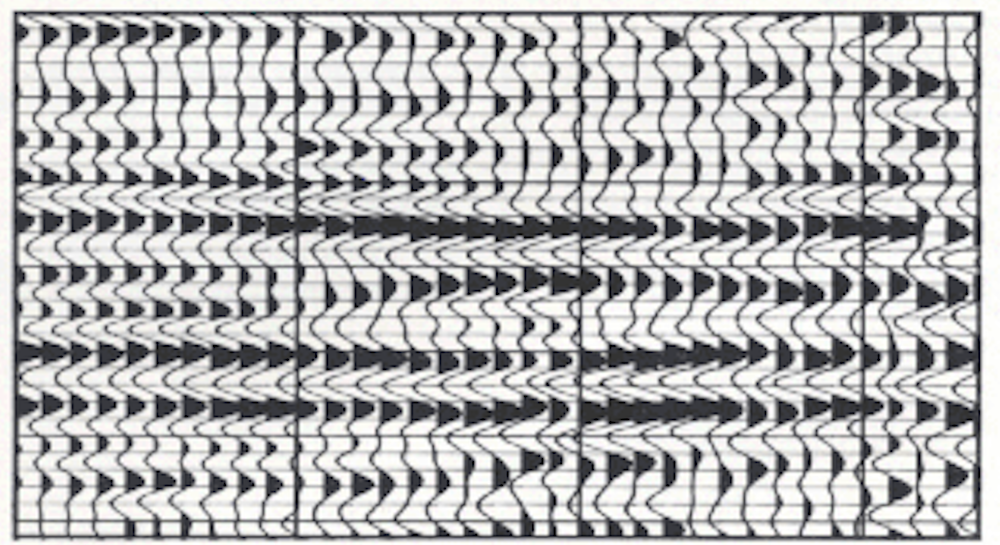
All of this was implemented on early Apple hardware, where memory and compute limitations required careful control of both data representation and algorithm design.
Applied Systems Development
(1990–Present)
- Designed and implemented a cross-platform assembler in ANSI C for Mac and Alpha systems, targeting a custom CPU architecture
- Data & Device Integration — Casio ↔ Mac backup, synchronization, and CRUD data systems
- Measurement & Modeling Systems — Residual Limb Digitizer, Self Hearing Test
- Established early web presence (1995) for service delivery and client engagement
- Designed and implemented network-based international communication solutions using university systems prior to widespread internet availability
- Developed early-generation websites using HTML, leading to ongoing client-driven web development work
- Early Mapping Systems — USA mapping system developed prior to modern web-based map platforms
- Designed and implemented an early web-based control system for a camera-equipped robotic vehicle, enabling real-time remote operation through structured command and servo control logic
- Internationalized Domain Systems (IDN) — Contributed to early IDN efforts enabling Unicode domains (example implementations)
- Web Applications — Designed and built numerous production websites and data-driven systems
- Rule-Based AI Systems — Quarters Game and other structured decision systems
- Scheduling & Optimization Systems —
Built systems to manage complex constraints including:
- Student / assistant scheduling across locations with travel constraints
- Teacher / course / room assignment using AI-based optimization
- Institutional Systems — Developed accreditation support systems enabling real-time verification of course requirements against instructor qualifications for external review bodies
- Education & Instruction (2007–Present) — For nearly two decades, I have taught college-level courses in mobile application development (Android and iOS), web development, programming, and database systems. I serve as course coordinator across multiple disciplines, responsible for curriculum design, course structure, and alignment with current industry practices. My courses emphasize practical problem-solving, clarity of thinking, and the ability to build functional systems—not just write code. Students trained under this approach have gone on to develop applications, launch businesses, and apply structured thinking to a wide range of technical and non-technical fields.
These systems consistently addressed real-world constraints — incomplete data, competing requirements, and the need for clarity — reinforcing a practical, system-oriented approach that continues in my current work.
Earlier Research & Systems Work
(1980s)
Earlier work included development of scientific, medical, and industrial systems involving signal processing, data modeling, and hardware integration.
- Seismic data analysis, digital filtering, FFT, and synthetic seismogram systems
- Medical systems including EKG signal analysis and optical microscopy digitization
- Industrial control systems using fuzzy logic for process optimization
- Remote sensing and data acquisition systems across multiple physical measurements
Industry Influence
(1980s)
In the early 1980s, my work extended beyond software development into advocating for a fundamental shift in how geophysical work was performed.
At a time when most of the industry relied on centralized mainframe systems, I promoted the use of desktop computing for geologists and geophysicists — enabling faster interpretation, greater independence, and more practical decision-making.
This included presenting to Exxon on why technical professionals should have computing capability directly at their desks — a position that faced significant resistance within the industry at the time.
My publications and presentations during this period helped move computational tools from centralized systems to the individual practitioner.
These efforts established a consistent approach to problem-solving: observe real-world behavior, model it, and build practical systems around what the data reveals — a pattern that continues to guide my work today.